Texas Politics & Civic Engagement
So keep fighting for freedom and justice, beloveds, but don’t forget to have fun doin’ it. Be outrageous… rejoice in all the oddities that freedom can produce. And when you get through celebrating the sheer joy of a good fight, be sure to tell those who come after how much fun it was!
— Molly Ivins
'Widespread Rot': How the Texas Funeral Service Commission Imploded
A Houston Chronicle investigation found the Texas agency that regulates funeral homes is struggling with missing files, high staff turnover, and complaints that go unanswered for more than a year. Executive Director Scott Bingaman was fired after alleging 'widespread rot' at the commission, and Chair Kristin Tips now faces accusations of using her position to benefit her own San Antonio funeral home chain. The agency that was supposed to protect grieving Texans has become a cautionary tale about regulatory capture and political dysfunction.
65 articles · sorted newest first
Texas Funeral Service Commission — Full Coverage Archive
Texas Funeral Commission Implodes After Audit and Firings
A comprehensive look back at the TFSC's collapse: a 2023 state audit found cash left unsecured, a three-month gap in complaint tracking, and four former employees who still had network access after leaving. Reform efforts in 2024 under Bingaman and staff attorney Sarah Sanders began to make progress — then the floor dropped out. The Hoodline analysis draws on reporting from the Houston Chronicle, San Antonio Express-News, KERA, and the Dallas Morning News.
Richardson Mortuary Owners Charged with Abuse of Corpse
Six months after the TFSC issued an emergency cease-and-desist order against Richardson Mortuary in Houston, two of the funeral home's owners were criminally charged with abuse of corpse. The Houston Police Department's Major Offenders Division had previously taken custody of 89 sets of cremated remains from the facility. The case intensified public scrutiny of the commission's oversight failures and shaky recordkeeping.
Did Texas's Top Funeral Regulator Illegally Lobby the Legislature?
KERA News reported that former TFSC staff alleged Chair Kristin Tips improperly advocated for bills in the Texas Legislature — potentially violating state lobbying rules. Tips testified in favor of legislation that would cap mental-anguish damages for funeral home mistakes, a move critics say directly benefited her own Mission Park Funeral Chapels business. Legal experts told KERA the rules for when agency leaders can testify despite personal financial stakes remain dangerously murky.
Judge Says Texas Veteran Deserves Funeral Director License — So Did Fired Agency Staff
A judge recommended that the TFSC grant a Houston-area Army veteran his funeral director license after the commission had repeatedly denied him — a case that fired agency staff had also flagged as an example of the commission's dysfunction. The case became a symbol of how the agency's internal turmoil was spilling over into harm for ordinary Texans trying to navigate the licensing process.
TFSC Fires Fifth Staffer in Seven Weeks Amid Ongoing Turmoil
The Texas Funeral Service Commission fired its fifth employee within seven weeks, raising serious questions about how the understaffed agency would continue to function. The Houston Chronicle reported that each fired staffer had echoed allegations that Chair Kristin Tips engaged in misconduct. KERA News confirmed that Bingaman's lawsuit alleges Tips misused state resources to lobby for legislation that would benefit her own funeral home chain.
CAIR Calls on Governor Abbott to Remove TFSC Chair After Anti-Islam Texts
The Council on American-Islamic Relations (CAIR) formally demanded that Governor Greg Abbott remove TFSC Presiding Officer Kristin Tips after KERA News revealed she had shared anti-Islam texts with the agency's executive director. CAIR cited the texts as evidence of bias in the commission's investigation of the East Plano Islamic Center and called for an independent review of all TFSC decisions involving Muslim funeral practices.
Head of Texas Funeral Commission Shared Anti-Islam Media, Pictures of Muslim State Rep in Texts
Text messages obtained by KERA News reveal that TFSC Presiding Officer Kristin Tips sent then-Executive Director Scott Bingaman anti-Islam graphics and a video calling a planned Muslim community 'a breeding ground for terrorists.' Tips also shared photos of Muslim state Rep. Suleman Lalani at the Capitol and a screenshot of him taking his oath on a Quran. The texts surfaced amid the commission's investigation into the East Plano Islamic Center. Bingaman replied, 'Not a fan… tough to be tolerant when taught hate.'
Head of Texas Funeral Commission Shared Anti-Islam Media, Pictures of Muslim State Rep in Texts
Text messages obtained by KERA News show the presiding officer of the state's funeral regulation agency sharing an anti-Islam infographic and videos with the agency's former executive director during the period when the agency was targeting the East Plano Islamic Center with a cease-and-desist order.
Texas Funeral Commission Drops Lawsuit Against Ex-Staffers After Attorney General Pushback
Just days after filing suit against former staffers who had spoken publicly about the agency's dysfunction, the Texas Funeral Service Commission abruptly dropped the lawsuit. KERA News reported the reversal came after the Attorney General's office signaled it would not defend the commission's legal position. Critics called the episode a failed attempt to silence whistleblowers and said it demonstrated the commission's leadership was acting recklessly with taxpayer resources.
Without Explanation, Texas Funeral Regulator Drops Suit Against Ex-Staffers After Less Than a Week
The Texas Funeral Service Commission nonsuited its lawsuit accusing two ex-staff attorneys of violating attorney-client privilege — less than a week after filing it — without offering any explanation for the sudden reversal.
Texas Funeral Commission Sues Ex-Staffers Over Public Statements
The TFSC filed suit against former staffers including Bingaman and attorneys who had spoken publicly about conditions at the agency — then abruptly dropped the suit against staff attorney Sarah Sanders just one week after filing it. Critics called the lawsuit an attempt to silence whistleblowers. The San Antonio Express-News reported the commission 'muzzled its own attorneys' in the process.
Texas Funeral Commission Sues Ex-Staffers Over Public Accusations, Allegedly Recording Conversations
After interviews with KERA News about their firings from the Texas Funeral Service Commission, the regulatory agency sued two ex-staff attorneys for allegedly violating their continuing obligations of confidentiality and for recording conversations without consent.
TFSC Firings, Whistleblowers & a Cease-and-Desist: The Commission's Summer of Chaos
KERA News reported that the Texas Funeral Service Commission sent a cease-and-desist letter to fired staffers, warning them not to speak publicly about the agency. The Attorney General's office was also drawn in as the commission's legal battles multiplied. Fired employees — including in-house attorneys — alleged Chair Kristin Tips directed staff to cover up misconduct and retaliated against anyone who raised concerns. The AG's office's involvement raised new constitutional questions about the commission's conduct.
Ex-Staffers Spoke Out Against the Texas Funeral Commission. Then Came the Cease-and-Desists.
Two attorneys recently fired from the state's funeral regulation agency say the Attorney General's office sent them cease-and-desist letters shortly after they spoke about their experiences with KERA News. Critics called the letters an attempt to silence whistleblowers.
'Kristin Tips Has No Business' Running the Funeral Commission: Attack Ad
A viral one-minute attack ad declared that Kristin Tips 'has no business overseeing the Texas Funeral Service Commission,' calling on Governor Greg Abbott to remove her. The San Antonio Express-News reported the ad emerged amid mounting turmoil at the TFSC and legal woes at Mission Park Funeral Chapels, the San Antonio chain Tips runs. Critics argue that having a funeral home owner chair the agency that regulates funeral homes is a textbook conflict of interest.
Texas Funeral Commission Muzzles Attorneys With Lawsuit, Critics Say
The Texas Funeral Service Commission's lawsuit against two fired staff attorneys drew immediate criticism from legal observers who said the agency was using litigation to silence whistleblowers and chill future disclosures about alleged misconduct at the agency.
AG Ken Paxton Sends Cease-and-Desist to Fired TFSC Attorney Over Media Disclosures
On July 30, 2025, Assistant Attorney General Steven Ogle — representing the Texas Funeral Service Commission — sent a cease-and-desist letter to Sarah Sanders, a fired TFSC in-house attorney. The letter accused Sanders of breaching her 'legal and ethical obligations' to TFSC by communicating with members of the press about confidential and privileged information. The OAG warned that further disclosures 'may result in action to protect TFSC's lawful expectations of confidentiality and privilege.' Critics called the letter an attempt to silence a whistleblower.
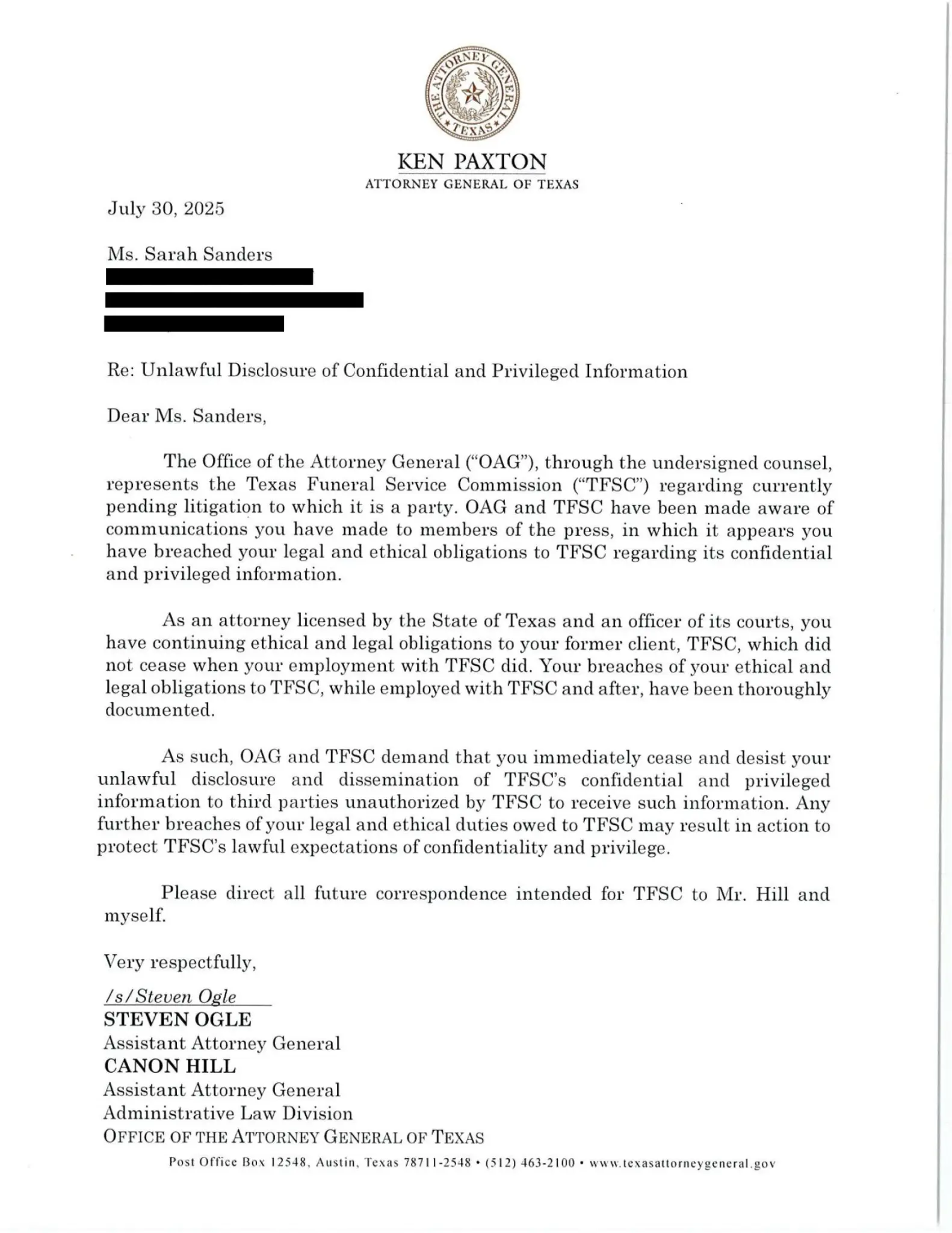
CLICK TO VIEW FULL DOCUMENT
Fired TFSC Staffers Allege Unethical Behavior and Retaliation by Agency Head
Two in-house attorneys fired by the TFSC on July 21 publicly backed former Executive Director Bingaman, alleging Chair Kristin Tips engaged in unethical behavior and retaliation. The fired staffers cited a letter from a previous executive director who had also raised red flags about the agency allegedly discriminating against veterans and resisting oversight. Commissioners claimed the firings were for 'lack of candor' and poor leadership.
Texas Funeral Commission Walks Back Claims Against East Plano Islamic Center
Weeks after ordering the East Plano Islamic Center to stop performing Islamic funeral rites, the Texas Funeral Service Commission quietly walked back key claims in its cease-and-desist order. KERA News reported that the agency's own investigation found EPIC was not operating as a funeral establishment — contradicting the basis of the original order. Critics said the reversal exposed the commission's enforcement as legally shaky and potentially motivated by religious bias.
EPIC Sues to Resume Funeral Services After Cease-and-Desist from Texas Funeral Authority
The East Plano Islamic Center (EPIC) filed suit in Travis County against the Texas Funeral Service Commission after the agency ordered the mosque to stop performing Islamic funeral rites. EPIC argues the cease-and-desist order violates state law and the mosque's First Amendment rights. Since the order, 11 congregants died without receiving funeral rites at their home mosque. Islamic law requires burial within 24 hours. EPIC partners with licensed funeral homes — it has never operated as a standalone funeral establishment, attorneys say.
Former Executive Director Sues Texas Funeral Services Commission
Scott Bingaman filed a civil lawsuit against the Texas Funeral Services Commission and five named commissioners — including Chair Kristin Tips — alleging he was wrongfully fired in retaliation for raising concerns about misconduct and conflicts of interest. The lawsuit alleges Tips misused state resources and that the commission violated state whistleblower protections.
Complaints Against Texas Funeral Homes on the Rise
Over 1,400 complaints have poured into the Texas Funeral Service Commission since 2020. Golden Gate Funeral Home in Dallas alone has faced 38 complaints in five years — including the accidental shipment of a stillborn child's remains to a laundry business in Louisiana. Families describe a broken system where complaints go unanswered for more than a year.
Executive Director of Texas Funeral Service Commission Fired
During the TFSC's regularly scheduled meeting, commissioners voted to fire Scott Bingaman, the agency's executive director. Bingaman had previously sent a scathing letter accusing the commission of 'widespread rot' and alleging Chair Kristin Tips had conflicts of interest. The firing set off a months-long cascade of lawsuits, additional firings, and public scrutiny of the agency.
Muslim Families in Plano Fight for the Right to Bury Their Own Dead
Before the TFSC issued its cease-and-desist against the East Plano Islamic Center, KERA News documented the growing tension between Texas funeral regulations and Islamic burial traditions. Muslim families in the Dallas-Fort Worth area described the difficulty of complying with a 24-hour burial requirement under Texas law that requires involvement of a licensed funeral director — a rule that can conflict with Islamic law requiring burial within 24 hours of death.
Texas Medical School President Resigns After Investigation Revealed Bodies Used Without Consent
The president of the University of North Texas Health Science Center, Dr. Sylvia Trent-Adams — a former acting U.S. Surgeon General — resigned effective January 31, four months after NBC News revealed the center had dissected and studied hundreds of unclaimed bodies without the consent of the dead or their families. Over five years, the center received about 2,350 unclaimed bodies from Dallas and Tarrant counties, leasing dissected remains to biotech companies and the U.S. Army for approximately $2.5 million per year. The Texas Funeral Service Commission had also ordered the center to halt its illegal water cremation practice in November.
The Funeral Home That Kept Bodies for Years — and the Family That Fought Back
Esquire's deep-dive investigation into the Javian Major funeral home case examines how a Texas funeral home held bodies for years without proper burial, and the devastating toll on grieving families who trusted the system to protect them. The case raises urgent questions about regulatory oversight — and whether the Texas Funeral Service Commission, already mired in its own scandals, has the capacity to protect the most vulnerable Texans at their most vulnerable moments.
TFSC Self-Evaluation Report 2025 (Sunset Review)
The Texas Funeral Service Commission's own self-evaluation report submitted to the Texas Sunset Advisory Commission in 2025, detailing the agency's current operations, staffing, budget, and regulatory activities ahead of its scheduled Sunset review. Filed amid ongoing controversy over staff firings and whistleblower retaliation allegations.
Texas Medical School Ordered to Stop Liquefying Bodies After Using Them for Training
The Texas Funeral Service Commission sent a cease-and-desist letter to the University of North Texas Health Science Center in Fort Worth, ordering it to immediately halt its practice of alkaline hydrolysis — or 'water cremation' — which the commission said is illegal under Texas law. The TFSC threatened $5,000-per-day fines and license revocation. The order came after NBC News revealed the center had dissected and studied hundreds of unclaimed bodies without consent, prompting the center to suspend its body donation program.
Naming the Dead: Hundreds of Unclaimed Bodies Were Sent to a Texas Medical School
NBC News published the names of more than 1,800 people whose unclaimed bodies were sent by Dallas and Tarrant counties to the UNT Health Science Center in Fort Worth since 2019. Over five years, more than 830 of those bodies were dissected, studied, and in some cases leased to medical schools, the U.S. Army, and for-profit biotech companies — without the consent of the deceased or their families. The Texas Funeral Service Commission regulates body donation in Texas and may be able to provide information to affected families.
Mission Park Funeral Chapels Faces Lawsuit Over Ashes Mix-Up
A San Antonio family sued Mission Park Funeral Chapels after the funeral home allegedly returned the wrong cremated remains. The lawsuit is the latest in a series of legal actions against the company, which is owned by Service Corporation International.
Lawsuits Allege San Antonio Funeral Home Switched Bodies of Two Elderly Women
The bodies of two San Antonio women who died 10 days apart in November were switched by Mission Park Funeral Chapels and Cemeteries, according to separate lawsuits filed by the women's families. The mix-up meant each family buried the wrong person.
Lawsuit Claims Funeral Home Switched Up Two Mothers' Bodies, Buried the Wrong One
Two families are suing Mission Park Funeral Home after the bodies of two mothers were allegedly switched. A lawsuit says Catalina Cervantes, 85, died Nov. 11, 2020 — and her family later discovered another woman had been buried in her place.
Bodies Swapped at Funeral Home Leads to Wrong Person Buried, Lawsuit Alleges
A San Antonio family filed suit against Mission Park Funeral Chapels after discovering their loved one had been buried in the wrong grave. The lawsuit alleged the funeral home confused the identities of two deceased women and conducted services for the wrong families.
Trial Over Body Stolen From San Antonio Funeral Home Begins
The civil trial over the disappearance of Julie Mott's body from Mission Park Funeral Homes began in San Antonio. Mott's family alleged the funeral home allowed her body to be stolen from the casket, and that the company covered up the incident.
Jury Deciding Civil Case Involving Body Missing From Funeral Home
A San Antonio jury began deliberating in the civil case involving Julie Mott's body, which disappeared from Mission Park Funeral Homes in 2015. The case drew national attention to the lack of oversight of the funeral industry in Texas.
Service Corporation International: A Multi-Billion Dollar Company That Wants to Bury You
An in-depth look at Service Corporation International, the nation's largest funeral conglomerate, which operates under dozens of local brand names. SCI's business practices and its relationship with state funeral regulators have been the subject of controversy for decades.
TFSC Self-Evaluation Report (Sunset Review — Earlier Cycle)
An earlier self-evaluation report submitted by the Texas Funeral Service Commission to the Sunset Advisory Commission, providing the agency's own account of its regulatory performance, complaint resolution processes, and organizational structure. Useful for comparing how the agency characterized itself versus what independent investigators found.
TFSC Sunset Staff Report with Final Results
The Texas Sunset Advisory Commission staff report on the Funeral Service Commission, including the final legislative results of the Sunset review. This document captures the commission's findings, recommendations, and the ultimate outcome of the review process — a key record for understanding how the Texas Legislature responded to documented regulatory failures.
TFSC Sunset — Statement of Legislative Intent (2003, 78th Legislature)
The Statement of Legislative Intent issued by the Texas Sunset Advisory Commission regarding the Funeral Services Commission during the 78th Legislature (2003). This document records what the Legislature intended when it voted to continue the agency, providing a benchmark against which subsequent regulatory conduct can be measured.
TFSC Sunset — Response to Legislature (2003, 78th Legislature)
The Texas Funeral Service Commission's formal response to the Texas Legislature following the 2003 Sunset review, documenting how the agency planned to implement the Legislature's directives and address identified deficiencies. A critical accountability document showing whether the agency followed through on promised reforms.
TFSC Sunset Staff Report (2003, 78th Legislature)
The full Texas Sunset Advisory Commission staff report on the Funeral Services Commission for the 78th Legislature (2003), providing an independent assessment of the agency's management, regulatory effectiveness, and compliance with its statutory mandate. The report identified persistent structural problems that would continue to plague the agency for decades.
Texas Sunset Commission Staff Report on the Funeral Services Commission (2001)
The Texas Sunset Advisory Commission's 2001 staff evaluation report on the Texas Funeral Service Commission, examining the agency's performance, structure, and whether it should continue to exist. The report documented systemic problems with the agency's handling of consumer complaints.
TFSC Sunset Staff Report (2001, 77th Legislature)
The Texas Sunset Advisory Commission staff report on the Funeral Services Commission for the 77th Legislature (2001), evaluating the agency's performance and making recommendations for continuation or abolishment. This report was produced during the same period as major investigative journalism exposing the SCI body-switching scandal and TFSC regulatory failures.
Who Is Eliza May? The Woman Who Ran Texas Funeral Regulation Under Bush
Salon profiles Eliza May, the director of the Texas Funeral Service Commission under Governor George W. Bush, whose tenure was marked by allegations of regulatory capture and failure to act on consumer complaints against SCI, the nation's largest funeral conglomerate.
The Funeral Scandal Time Line: From SCI to Bush to the TFSC
A chronological timeline of the Texas funeral industry scandal, tracing the connections between Service Corporation International, Governor George W. Bush's administration, and the Texas Funeral Service Commission's failure to investigate consumer complaints.
A Pattern of Intimidation — Or Just Business? Austin Chronicle on the TFSC
The Austin Chronicle examines whether the Texas Funeral Service Commission's treatment of consumer advocates and whistleblowers constitutes a pattern of intimidation or is simply aggressive regulatory enforcement on behalf of the industry it oversees.
A Grave Injustice: Austin Chronicle Investigates TFSC Consumer Failures
The Austin Chronicle investigates how the Texas Funeral Service Commission failed to protect consumers from predatory practices by large funeral conglomerates, and how the agency's leadership had close ties to the industry it was supposed to regulate.
The DA's Dodge: Why Prosecutors Wouldn't Touch the Texas Funeral Scandal
The Austin Chronicle examines why district attorneys declined to pursue criminal charges in the Texas funeral industry scandal, despite evidence of consumer fraud and regulatory misconduct at the Texas Funeral Service Commission.
Robert Bryce: Investigative Reporting on the Texas Funeral Industry
Journalist Robert Bryce's investigative archive on the Texas funeral industry scandal, including his reporting on the Texas Funeral Service Commission, SCI, and the political connections that allowed regulatory failures to persist for decades.
TFSC Sunset Staff Report (1991, 72nd Legislature)
The earliest available Texas Sunset Advisory Commission staff report on the Funeral Services Commission, dating to the 72nd Legislature (1991). This foundational document reveals that concerns about the agency's regulatory effectiveness and industry capture were present decades before the scandals that would eventually dominate headlines in the 1990s and 2020s.
The TFSC Story in Video
A curated playlist of news reports, legislative hearings, and industry coverage documenting the Texas Funeral Service Commission controversy.
Texas Sunset Commission Review of TFSC — Funeral Consumers Alliance Public Testimony
Funeral Consumers Alliance of Texas · August 30, 2018
Representatives from the Funeral Consumers Alliance of Texas deliver public testimony before the Texas Sunset Advisory Commission, arguing the TFSC favors the funeral industry over consumers and calling for major reforms to protect the public.
Playlist · 18/18 Videos